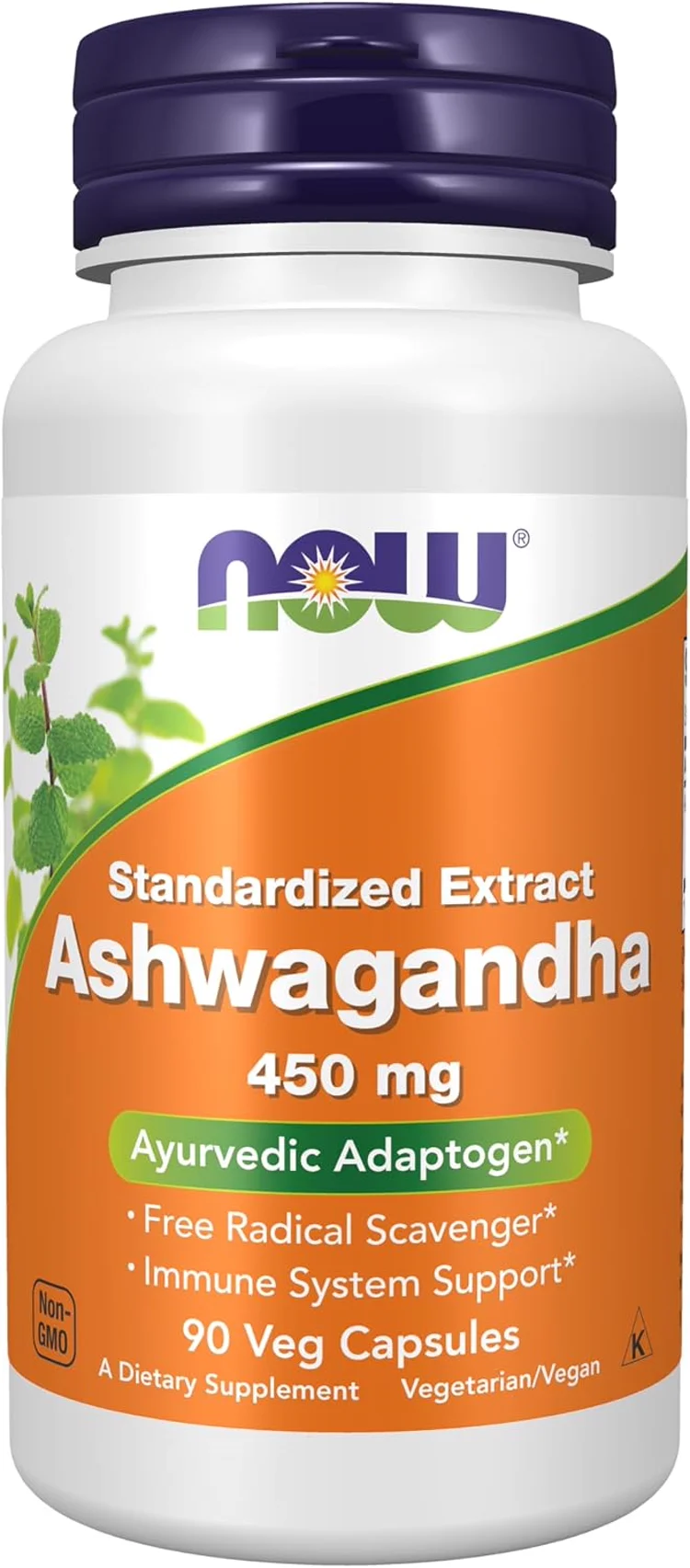
At a glance
- Active ingredientAshwagandha Extract (Withania somnifera), Root & Leaf
- StandardizationMin. 2.5% total withanolides (11 mg per capsule)
- Serving size450 mg per veg capsule
- Suggested use1 capsule, 2–3x daily, with food
- Other ingredientsHypromellose (veg capsule), stearic acid (vegetable source), rice flour
- Free ofYeast, wheat, gluten, soy, milk, egg, fish, shellfish, tree nut, sesame
- CertificationsNon-GMO, vegetarian/vegan, kosher, GMP-facility produced
- Package sizes90 or 180 veg capsules
Also sold in a 180-capsule bottle if you go through it quickly at the 2–3 capsule serving.
What's actually in the bottle
Each veg capsule contains 450 mg of ashwagandha (Withania somnifera) root and leaf extract, standardized to a minimum of 2.5% total withanolides — that works out to roughly 11 mg of withanolides per capsule, the compound class most ashwagandha research uses as its potency marker. The only other ingredients are the vegetable capsule shell (hypromellose), stearic acid, and rice flour used as a flow agent. There's no proprietary blend hiding the amount of anything, which is worth calling out — a fair number of stress-support products list ashwagandha as one line inside a blend and never say how much is actually in there.
The label directs 1 capsule, 2 to 3 times daily, ideally with food. At the top of that range (3 capsules), that's 1,350 mg of extract and roughly 33 mg of withanolides a day, split across doses rather than taken all at once.
NOW's extract is a root-and-leaf blend standardized to 2.5% withanolides. Several of the extracts used in published clinical research (below) are root-only, standardized to a higher 5% withanolide content, and dosed as a single measured extract rather than split into a 2–3x daily range. That doesn't make NOW's version ineffective, but it does mean the research on ashwagandha in general isn't automatically the research on this specific formula — a distinction most product pages skip past.
What the research on ashwagandha actually shows
We're deliberately staying in the lane this herb's research base actually supports well: everyday stress, cortisol, sleep quality, and attention. That's also where NOW positions this product on its own label — "Ayurvedic Adaptogen," free radical scavenger, immune system support — and it's the honest scope of what follows.
A 60-day trial in adults with chronic stress
64 adults with chronic stress took 300 mg of a high-concentration, full-spectrum root extract (KSM-66, standardized to at least 5% withanolides) twice daily, or a placebo, for 60 days. By day 60, the ashwagandha group showed a 27.9% drop in serum cortisol versus a 7.9% drop on placebo (P=0.002), and a 44.0% reduction in Perceived Stress Scale scores versus 5.5% on placebo (P<0.0001).
A 10-week trial in adults with diagnosed insomnia
60 adults with insomnia took 300 mg of a root extract twice daily, or a placebo, for 10 weeks. The ashwagandha group fell asleep significantly faster (sleep onset latency dropped from roughly 33.9 to 29.0 minutes, P=0.019) and showed a meaningfully higher sleep-efficiency score than placebo by the end of the trial.
A 90-day trial measuring memory, error rate, and attention
125 adults with moderate stress took a 300 mg sustained-release root extract (standardized to 15 mg withanolides by HPLC) once daily, or a placebo, for 90 days, with cognition measured on a standardized computerized test battery. The ashwagandha group improved significantly more than placebo on visual recall memory, made significantly fewer errors on a paired-associates memory task, and scored higher on a sustained visual-attention measure. The same trial's secondary measures also showed significant reductions in perceived stress and cortisol, and improved sleep quality — consistent with the two trials above.
Every trial cited here used a specific, separately branded extract at a fixed, single-source dose — not NOW's exact root-and-leaf, 2.5%-standardized formula. We're linking NOW's product to the general evidence base for this herb and this compound class, not claiming NOW ran or sponsored any of these trials.
Who this is a reasonable fit for
If you're looking for a plain, single-ingredient ashwagandha capsule — no proprietary blend, a clearly stated withanolide standardization, and a company that's been making supplements since 1968 with third-party GMP certification — this is a straightforward, well-labeled option. It suits someone who wants to try an evening or twice-daily adaptogen routine for everyday stress and sleep quality and would rather start with a plain extract than a multi-ingredient stress formula.
Who should skip it or check with a doctor first
- Pregnant or nursing. The label advises against use during pregnancy or while nursing.
- Thyroid conditions or thyroid medication. Ashwagandha has been shown in some research to raise thyroid hormone levels; anyone with a thyroid condition or on thyroid medication should talk to a doctor before adding it.
- Autoimmune conditions. Because ashwagandha may stimulate immune activity, it's worth a conversation with a doctor first if you have an autoimmune condition or take immune-suppressing medication.
- Sedatives or anti-anxiety medication. Given its calming effect on the stress response, combining it with sedative medication without medical guidance isn't a good idea.
- Ulcers or GI sensitivity. NOW's own label flags checking with a healthcare professional if you have a gastrointestinal condition, including ulcers.
None of this is a substitute for actual medical advice — it's a summary of the cautions already on the label and in the surrounding research, so you know what to ask about before you start.
Bottom line
NOW Foods Ashwagandha 450 mg is a clean, single-ingredient, clearly labeled extract from a long-established supplement manufacturer, and it sits within a herb category that has real, repeated, human clinical research behind it for everyday stress, cortisol, sleep quality, and attention. The honest caveat is that NOW's specific root-and-leaf, 2.5%-standardized formula isn't the exact extract used in any of the trials above — so treat this as a reasonable, well-made way to try the ingredient, not a guarantee that you'll see the same numbers those trials reported.
This review is for general informational purposes only and isn't intended to diagnose, treat, cure, or prevent any condition. Talk to a healthcare provider before starting any new supplement, especially if you're pregnant, nursing, managing a thyroid or autoimmune condition, or taking prescription medication. Some links on this page are Amazon affiliate links — see our Affiliate Disclosure for details on how that works and how it's kept separate from what we recommend.